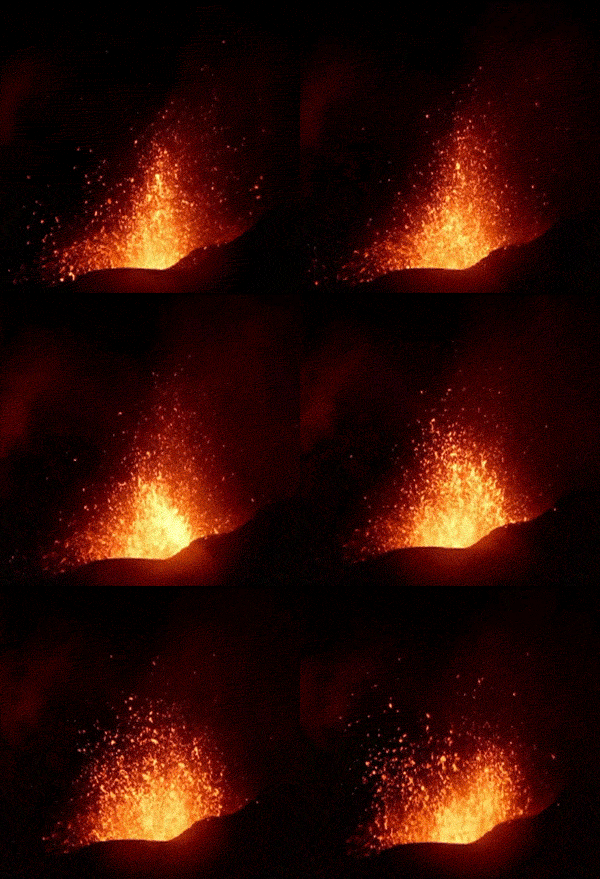

Hello VMSG. In this issue we’ll hear about recent winners of VMSG awards and student presentation prizes. We also have a reminder about the upcoming deadline for Student Bursaries and the Early Career VMSG Fieldwork Grant as well as reports from recent awardees. We also have some information about the MinSoc150 meeting that will celebrate 150 years of VMSG’s parent society, and a reminder about nominating people for MinSoc prizes. We also have a report from some members of the VMSG community who attended the Future Women and Nonbinary Leaders in Geoscience Field camp in January. (The header image is also a quick reminder that the VMSG Discord channel is out there to keep the community ticking over until our next meeting in 2027.) – David Neave (Newsletter Editor)
Every year VMSG confers awards on members across our community. You can find more about the awards here. This year we were thrilled to celebrate the following awardees in Southampton.
The VMSG Award: Paul Cole (University of Plymouth)
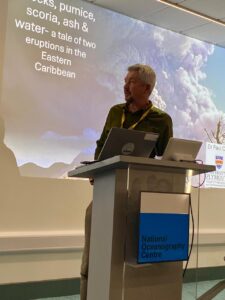
The Zeiss Post-doctoral Keynote Award: Emma Watts (Swansea University)
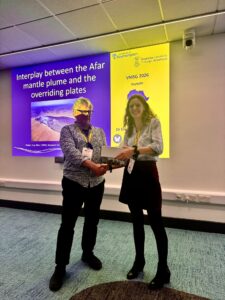
Amongst stiff competition from lots of excellent contributions we were also pleased to make the following awards for student presentations at VMSG 2026:
The Geoff Brown Prize for Best Student Poster: Rahul Subbaraman (The University of Manchester) for “Microstructural Record of Icelandic Crystal Mushes Preserved in Gabbroic Nodules”
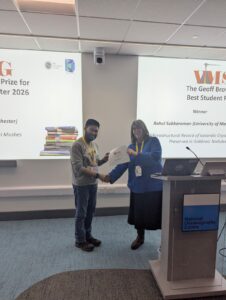
Honourable mentions: Katherine Wale (University of Bristol) for “Volcanic Ash Fall Risk to Marine Traffic and Infrastructure” & Kendra Ní Nualláin (University College Dublin) for “Tracing the Triggers: Modelling Dome Collapse Dynamics at Volcán de Colima”
The Bob Hunter Prize for Best Student Oral Presentation: Jacob Nash (University of Southampton) for “The submarine record of the largest volcanic eruption of the 21st century”
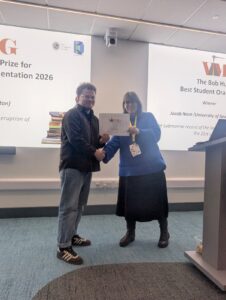
Honourable mention: Rebekah Rhodes (University of Oxford) for “Controls on Fissure Location and Fire Fountain Dynamics: Insights from Webcam Observations of the Svartsengi Volcanic System, Iceland”
The Mineralogical Society is celebrating its 150th birthday in 2026!
To mark this milestone, the MinSoc is running a celebratory conference:
Mineralogical Society at 150: Past discoveries and future frontiers
The meeting will be held 23–25th June 2026 at the University of Manchester.
There will be a lots going on at this meeting for members of the VMSG community, especially for those with interests that overlap with many of the other special interest groups of the MinSoc, including the Geochemistry Group, Mineral Physics Group, Metamorphic Studies Group and Mineral Deposits Studies Group.
The deadline for early bird registration is here the 20th of March.
Lots more information can be found here: https://minsoc-150.org/
The Mineralogical Society would like to draw your attention to the following awards that are now open for nominations!
Neumann Medal
The Neumann Medal will be awarded annually to a mid-career scientist who has made an outstanding contribution to applied mineralogy, clay mineralogy, environmental mineralogy, geochemistry, geomicrobiology, metamorphism, mineral physics or volcanology and magmatic studies, reflecting the diverse and worldwide interests and membership of the Society. Evidence of such excellence should be in the form of the impact of the applicant’s/nominee’s work, their publications, service to industry, outreach/promotion of science, leadership or other service to the community, teaching and work to improve equality, diversity and inclusivity in our science.’ Nominees/applicants do not have to be Members of the Mineralogical Society or nationals of the UK or Ireland.
Details at: https://www.minersoc.org/neumann
Collins Medal
The Collins medal will be awarded annually to a scientist who, during a long and active career, has made an outstanding contribution in applied mineralogy, clay mineralogy, environmental mineralogy, geochemistry, geomicrobiology, metamorphism, mineral physics or volcanology and magmatic studies, reflecting the diverse and worldwide interests and membership of the Society. Evidence of such excellence should be in the form of the impact of the applicant’s/nominee’s work, their publications, service to industry, outreach/promotion of science, leadership or other service to the community, teaching and work to improve equality, diversity and inclusivity in our science.
Details at: https://www.minersoc.org/collins-medal
Max Hey Medal
The Max Hey Medal will be awarded annually to a scientist who is in the early stage of their career. Its purpose is ‘To recognise existing and ongoing excellence in applied mineralogy, clay mineralogy, environmental mineralogy, geochemistry, geomicrobiology, metamorphism, mineral physics or volcanology and magmatic studies, reflecting the diverse and worldwide interests and membership of the Society. Evidence of such excellence should be in the form of the impact of the applicant’s/nominee’s work, their publications, service to industry, outreach/promotion of science, leadership or other service to the community, teaching and work to improve equality, diversity and inclusivity in our science.
Details at: https://www.minersoc.org/hey-medal
And new this year….
Guppy Medal
The award aims to showcase the vital role of technicians in enabling and delivering high-quality research. Technicians and experimental officers form a key part of almost all research teams delivering a wide variety of technical and analytical expertise. This award focuses specifically on the contributions of technicians in the fields of Mineralogy and Earth Sciences, and aims to showcase the leading contributions of individuals and teams in the delivery of world class research and development.
In addition to individuals from universities and research institutes, this award is also open to technical teams, as work from technicians in labs is often collaborative. This would particularly benefit the collaborative team work at national facilities. Nominations are open for individuals in even years, e.g. 2026 and to teams in odd years, i.e. the following year, 2027.
The awards will be presented the following year and consist of a Certificate and a Plaque to be awarded at an appropriate scientific event of the Society.
Details at: https://www.minersoc.org/guppy-award
The deadline for receipt of nominations for all awards is 17th April 2026. – Kevin Murphy (Executive Director, Mineralogical Society of the UK and Ireland)
Sofia Della Sala (University of Oxford) writes…
I was able to attend VMSG 2026 at the National Oceanography Centre in Southampton to present my current PhD work during the Marine Volcanism session. This was a great opportunity as my research does not usually fit into terrestrial volcanism themes. VMSG is such a friendly conference that it felt like the perfect place to present preliminary research and get some initial feelings on my interpretations. I received some great questions and was very pleased when people approached me after my talk during the breaks to ask questions or say I had done a good job. I was also very happy to present in VMSG’s first-ever marine volcanism session. I hope we span more disciplines like this in the future as it allowed for a really diverse and varied conference schedule.
Prior to the conference, I took part in the Marine Core workshop which focused on identifying and interpreting volcanic ash layers in marine sediment cores. This was a unique workshop and highlighted how much is still unknown within marine volcanology. We had the opportunity to see and examine cores from different depositional settings, which made for some great discussions. We also got to understand what an untapped resource marine cores can be, since they are available for anyone to request samples from and could lead to some great project ideas.
With that in mind, I was also able to use VMSG as a networking opportunity as I am approaching the final stage of my PhD and eager for insights into post-docs. I had some great discussions with people and even have maybe got an idea for a proposal!
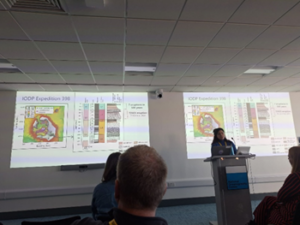
I am so grateful to have been able to be supported to attend VMSG during my final year and see my work slot into this community of marine volcanism. The conference had a lot of PhD students attending, which was great during the ice-breaker and conference dinner, it made me hopeful that these peers of mine would hopefully one day become my colleagues and we would be able to do some great science together in the future.
Rahul Subbaraman (University of Manchester) writes…
From January 5 to 7, 2026, I attended the Volcanic and Magmatic Studies Group (VMSG) annual meeting at the National Oceanography Centre in Southampton. Supported by a VMSG student bursary, this meeting provided a vital platform to present the ongoing novel aspects of my doctoral research. I presented a poster titled “Microstructural Record of Icelandic Crystal Mushes Preserved in Gabbroic Nodules” in the session on Magma Generation, Storage, and Transport. A core focus was the debut of MAPClean (Microstructurally Adaptive Pixel-level Cleaning), an open-source MATLAB toolkit I developed to automate the cleaning and segmentation of noisy EBSD datasets (available at: https://doi.org/10.5281/zenodo.18052287).
As I am currently in the final stages of my PhD, this meeting was an invaluable opportunity to “put my name out there” before submission. Beyond the technical sessions, the conference allowed me to connect with several potential collaborators and employers. These discussions regarding future research have been incredibly encouraging as I look toward my next steps after Manchester.
I also attended the “New Frontiers in the Petrological Toolbox” workshop led by Martin Mangler and Gregor Weber. The session offered excellent hands-on experience with machine-learning thermobarometers and a tour of the high-resolution geochemical mapping facilities at Southampton.
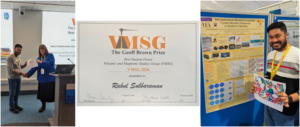
The meeting concluded on a high note as I was honoured to receive The Geoff Brown Prize for Best Student Poster. Having attended my first VMSG in London back in 2023, returning to win this award at my final student conference felt like a perfect full circle. I am sincerely grateful to VMSG for the financial support that allowed me to engage so fully with the UK community at this pivotal stage of my career.
The closing date for the next round of Student Bursaries and the Early Career VMSG fieldwork Grant is 15 March 2026 so here is a gentle reminder to get your nominations and applications in!
Student Bursaries
We welcome applications that offer funding to postgraduate researchers of up to £750 to support activities that would otherwise not be possible. Remember, PhD students in their first year are now eligible to apply but you still must have presented at a VMSG conference prior to the application deadline.
Please see the bursaries website for further details and to apply.
Early Career VMSG fieldwork Grant
At the July 2025 meeting of the VMSG Committee it was agreed to expand the previously established Henry Emeleus fieldwork award. This award was established in 2018, and named after Henry Emeleus (1930–2017), the internationally renowned igneous petrologist and field geologist.
We will retain this fieldwork award, and make it available to any early career researcher (postgraduate student, postdoctoral researcher or non-permanent university lecturer) who is looking to undertake volcanic and magmatic fieldwork- with a single award of up to £750 available each calendar year. Where the proposed fieldwork focusses on the Paleogene North Atlantic Igneous Province, this will be deemed the Henry Emeleus fieldwork award.
Please see the grant website for further details and to apply.
Please get in touch if you have any questions about the bursaries, grant or application process. – Katy Chamberlain (Awards & Bursaries)
In January, PhD and MRes students from the VMSG community headed to Cornwall to participate in the Future Women and Nonbinary Leaders in Geoscience Field camp, funded by the Opening Up the Environment (OUTE) NERC grant. Led by Katy Chamberlain (University of Liverpool), this novel leadership course aimed at empowering early career women and nonbinary people in geosciences. The 7-day course focused on leadership, science communication and application to our subject areas during field sessions. We acquired leadership skills and connections that we are excited to share within the wider VMSG community.
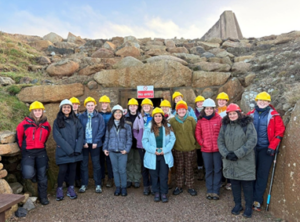
Exploring geoethics at the Geevor Tin Mine Museum. From left: Lydia Hemmings, Chaithanya Bhagavathi Parambu, Becky Hirst, Emily Baker, Mia Holt, Alexandria Tanciongco, Leah Gingell, Rebecca Hughes, Bhargvi Sharan, Holly Raynor, Alma Chavez, Hannah Little, Kate Williams, Grace Nielson, Katy Chamberlain, Saneeya Qureshi and Frankie Butler.
Hands-on workshops included: leading and designing field trips, writing grant proposals, working in groups diverse in academic and life experience, managing our own growth and development alongside that of the team and science communication video production.
We would like to extend our thanks to Katy Chamberlain, Hannah Little, Saneeya Qureshi and Kate Williams for excellent organisation, for leading informative, engaging and enjoyable sessions, and for empowering us to foster our own supportive cohort of PGRs.
Insights from VMSG participants
‘I found the course helpful because it was effective and not just talk. We were provided with effective skills to implement in our everyday life and impactful messages we could takeaway. We were presented with raw data about the number of women and enby in positions of power- this was truly staggering to hear. We had the chance to practice leadership in the exercises set each day in the field. Members of the cohort gained confidence over the 7 days on the field camp and more voices were being heard in group discussion, this was testament to the empowering nature of the course.’ – Frankie Butler (University of Cambridge)
‘This field camp gave me a safe space in which to explore my personal values and priorities, which will help shape how I choose to lead going forward. I came back to my university after the course feeling so much better prepared and able to tackle the challenges my PhD throws at me.’ – Bex Hughes (University of Manchester)
‘The experience for myself was invaluable. The week allowed me to network with like-minded individuals, establishing a community together and hopefully future collaborations. I now understand how to push myself out of my comfort zone, which I look forward to applying to further opportunities and my career.’ – Leah Gingell (University of Glasgow)
‘I thoroughly enjoyed the course and could see myself becoming more confident throughout the week. I loved how the course was set up to have classroom sessions learning the theory and then have the opportunity to go out into the field in beautiful Cornwall and put these skills into practice. It was such a welcoming and supportive space to learn and identify our strengths, weaknesses and worries when it comes to leadership. I feel that we have really been equipped with the necessary skills to all excel as leaders in the future. Every single person on the course was lovely and I’m excited to see everyone again soon!’ – Emily Baker (Cardiff University)
‘This was such an inspiring week spent with an amazing group of people. The environment was incredibly supportive and welcomed discussion surrounding the skills and qualities required for effective and informed leadership. This has given me the confidence to develop my own leadership practice, and I’m excited to see where this takes me in the future! – Mia Holt (University of Leeds)
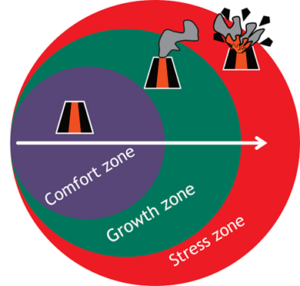
Personal development diagram, comfort zone, growth zone, stress zone. Rudimentary design by Butler.
Anna Theurel would like to share this MPhil opportunity at Durham University. Please contact Anna for more details: anna.theurel@durham.ac.uk
Welding under pressure: an experimental study of ignimbrite formation
Supervisors: Anna Theurel, Ed Llewellin, Madeleine Humphreys
External Collaborators: Fabian Wadsworth, LMU Munich
Sintering describes the process in which hot, fragmented volcanic particles (ash, pumice) adhere and fuse, either through viscous flow (melting and coalescence) or solid-state diffusion (atomic movement), forming denser, stronger volcanic rocks such as ignimbrites or lava domes, thereby reducing porosity and permeability. Sintering is one of the most essential processes during ignimbrite formation, as evidenced by the transition from loose, dispersed Pyroclasts to a welded, compact ignimbrite. Within this wide textural spectrum, ignimbrites are often characterized by heterogeneous layers with varying degrees of sintering. The degree of sintering and its precise influence on the physical properties (porosity, permeability…) of materials are difficult to constrain, as they depend on several parameters, such as the pressure applied on the material. This type of constraint is believed to drive deformation localization and sintering heterogeneity. These heterogeneous textures, generally associated with explosive eruptions, have also recently been observed in dome rocks, characteristic of effusive behaviour. To address this paradox, a recent conceptual eruption model proposes that pyroclast sintering can also occur in shallower conduits, thereby triggering lava-like eruptions. This hypothesis demands the redefinition of the explosive and effusive eruptive styles and challenges previously established boundaries between these behaviours.
Project Aims and Methods: This project aims to constrain the influence of external uniaxial stress on sintering. After 2D and 3D analyses of the different starting materials (to constrain the properties of the synthetic glass used), the candidate will conduct sintering experiments in a high-temperature oven at various timescales and under varying vertical loads. The samples will be analysed both quantitatively to constrain their porosity and permeability and qualitatively by examining their textures. The candidate will also characterize a broader conceptual model of sintering across several parameters, including the timescales for rounding and coalescence of glass particles, surface tensions, and capillary forces. The aim is to observe and describe differences in sintering with/without external vertical pressure, and to compare these samples with natural ignimbrite and dome rock samples. The outcomes of these experiments and models would apply to real-world volcanism, with the aim of improving our understanding of dynamic sintering in volcanic conduits and, to an extent, its influence on eruptive transitions.
Training and skills development:
Pre-requisites:
Apply via this link: www.dur.ac.uk/earth.sciences/postgraduate
For those not in Southampton, we were excited to announce that the next VMSG will be held in Cambridge in early January. Keep your eyes open for more details later in the year.
Do you have any job opportunities, PhD viva celebrations, or funding announcements that you would like to advertise? If so, please get in touch with David Neave.
Don’t forget to keep in touch with us and other volcanologists around the world. There are several ways you can do this: through the VMSG PhD and ECR directory (here), the Arizona State University mailing list (here), and the VMSG mailing list (here).