
After a break following the success of VMSG2026 in Southampton, the VMSG Newsletter returns for a bumper summer issue. As well as news about VMSG2027 and the next round of awards and bursaries, we have some changes to the VMSG Committee to report (and people to thank) and new openings on the VMSG Committee to announce alongside much more community news. – David Neave (Newsletter editor, outgoing)
Chairing the VMSG Committee serves as a constant reminder of the value of the volunteer. We have a fantastic committee who spend a lot of time thinking about how to bring our community together. I can see them doing this despite increasing pressures on each of them at their home organizations, and the uncertainty of ‘what next’ for our early career representatives. The annual cycle of awards brings in nominations for people who have long lists of amazing ways in which they have gone above and beyond to feed into what is a lively and supportive community of researchers and professionals at VMSG. Finally, this newsletter contains the announcement of our next January meeting, behind which is already a lot of hard work and planning from the volunteer Cambridge team!
Of course, there is a lot of evidence to suggest that the sense of achievement and community that comes with volunteering benefits the volunteer too – but nonetheless without these volunteers that sense of community would disappear faster than a tephra deposit in a rainstorm.
We can’t rely on things staying the same either: at this years January meeting we ‘polled’ attendees about how well we can use our time to best serve the most people. We are in the process of sending out a more general poll too – those who cannot make it to that meeting are as important as those who did! Watch this space!
In the meantime, we’ve a couple of committee spots that have opened up (see announcement) and please do consider nominating some brilliant community members for our awards. And, for all you wonderful volunteers – the committed committee sitters, the workshop wonders, the engagement enthusiasts and beyond – have a wonderful summer and take time to rest and recharge! – Jenni Barclay (VMSG Chair)
The VMSG Committee would like to extend their warmest thanks to Seb Watt (University of Birmingham) who has served as the Secretary for the past three years. Seb has done huge amounts of work behind the scenes to keep VMSG smoothly ticking over, and has made the rest of the committee’s lives considerably easier as a result. Thanks Seb!
Thanks also to Katie Preece (Swansea University) who will shortly be standing down as our Equality and Diversity Officer. Katie has continued to build on her predecessors’ efforts to try and make VMSG as welcoming and inclusive as possible. We’re particularly grateful for her efforts in producing our most recent Equality, Diversity and Inclusion Report.
Rahul Subbaraman (University of Manchester) has also recently finished serving as a Student Representative. We’d also like to thanks Rahul for all the work he’s put into building and supporting the VMSG student community over the past two years, from maintaining PhD project lists to supporting buddy schemes and a raft of other stuff besides!
We’d also like to welcome Fathia Lutfiananda (University of Edinburgh) who will be joining us as a new Student Representative. Fathia writes…
Hello everyone! I’m Fathia Lutfiananda, a third-year PhD student in Volcanology-Geography at the University of Edinburgh. I’m originally from Indonesia, and my research focuses on understanding how communities experience the risks posed by pyroclastic density currents (PDCs) and how disaster mitigation and evacuation strategies can be improved. As part of my PhD, I am reconstructing the history of PDC impacts by mapping fatalities, documenting the evolution of PDC footprints, and examining how hazard maps and evacuation strategies have changed over time. I’m delighted to be serving as one of the VMSG Student Representatives, and I look forward to supporting student engagement while helping foster the welcoming and inclusive community that first welcomed me into the UK volcanology community.
In a change of role, David Neave will be standing down from his role as Newsletter Editor to take up the role of Secretary that has been vacated by Seb Watt. – VMSG Committee
We are welcoming volunteers to join the VMSG committee from October 2026. These are for the Newsletter Editor, Equality and Diversity Officer and a general position as an Ordinary Member of the committee. Committee members participate in committee meetings and activities running through the year, including the annual winter meeting.
Terms usually run for 3 years. We welcome applications from related professionals or researchers working within VMSG’s remit. In the first instance please contact David Neave, the VMSG Secretary (david.neave@manchester.ac.uk) with a brief outline of your interest by Friday 31 August 2026. Please put ‘VMSG Committee Application’ in the email header. If you have questions about what is involved in the Newsletter Editor or Equality and Diversity Officer roles, please contact David Neave (david.neave@manchester.ac.uk) or Katie Preece (k.j.preece@swansea.ac.uk), respectively.
In the case of multiple candidates for each post, we will arrange an anonymous online vote for the VMSG community to elect the positions. We will use a collated list of applicant statements for this.
The VMSG aims to provide a supportive environment where all in the community are welcome and valued, and are keen to promote balance in terms of gender, ethnicity, religion, geographical location, physical ability, sexual orientation and socioeconomic background. An important part of helping to achieve this aim is to ensure that the VMSG committee fully reflects the diversity of our members.
Please forward this invitation to any individuals you believe might be interested in this opportunity and encourage them to apply! – VMSG Committee
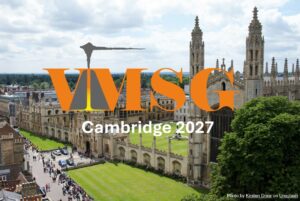
The Cambridge Local Organising Committee is delighted to welcome you to Queens’ College for the 2027 VMSG Annual Meeting, from 6–8 January 2027.
Founded in 1448, Queens’ College provides a stunning historic setting for the meeting and offers a unique opportunity to experience life at one of Cambridge’s oldest colleges.
As always, the scientific programme will feature sessions reflecting the breadth and diversity of volcanology and an optional programme of workshops will also be available on 5 January and on the morning of 6 January, ahead of the main conference.
Abstract submission and early-bird registration will open on 31 August and close on 23 October, with standard registration remaining open until 27 November. If you are planning to attend, we encourage you to book your accommodation as early as possible, as availability in Cambridge can be limited.
We look forward to receiving your abstracts and welcoming you to Cambridge in January! – VMSG Cambridge LOC.
Its awards and bursary nomination season again! The closing date for the next round of our annual awards and biannual student bursaries is 15 September 2026.
We are seeking nominations for our three awards: the VMSG Award, the Willy Aspinall Prize and Zeiss Postdoctoral Keynote Award. Please consider nominating someone who you feel has made a substantial impact in their area of research but also gone above and beyond to make a contribution to the research community. Here’s a description of the scope of each of these awards:
Please see the awards website for further details on each award and how to nominate. We particularly encourage nominations from historically under-represented groups to all these awards. It doesn’t matter if you haven’t nominated anyone for an award before- and if you have any questions please get in touch with the VMSG Awards officer if you have any questions: k.j.chamberlain@liverpool.ac.uk.
We also welcome applications for student bursaries, which offer funding to postgraduate researchers of up to £750 (increased from £500!) to support activities that would otherwise not be possible. Remember, PhD students in their first year are now eligible to apply but you still must have presented at a VMSG conference prior to the application deadline.
Please see the bursaries website for further details and to apply. – Katy Chamberlain (Awards and Bursaries) and VMSG Committee
Natasha Keeley (Keele University) writes…
Thanks to the support of the VMSG Student Travel Bursary, I was able to attend the European Geosciences Union (EGU) conference in Vienna from 3rd-8th May 2026. At the conference, I gave an oral presentation on part of my PhD research titled “Magmatic processes and timescales of the 726 CE eruption of the Kameni Volcano (Greece)” in the session GMPV10.2 Magmatic textures: petrological insights into igneous processes. I had some really engaging discussions after my talk with researchers working on volcanic petrology, magma processes, diffusion chronology and the South Aegean volcanic region, which gave me useful feedback and new ideas to think about as I continue developing my work into a paper.
I also attended a range of interesting talks and poster sessions related to the Aegean region, submarine volcanic eruptions, volcanic hazards, and petrology. It was especially valuable to hear about current research being carried out across different volcanic systems and new developments in analytical approaches. I discovered that there weren’t many presentations on submarine volcanic eruptions, so I especially appreciated the opportunity to discuss the topic with other researchers working in related areas. Alongside the volcanic petrology sessions, I also attended talks and discussions on topics outside my direct research area, including women in geoscience, volcanic hazards, hazard communication and volcanic monitoring which I found really interesting and important.
One of the highlights of the conference was catching up with familiar faces from previous VMSG conferences and volcanic workshops, friends from university, as well as meeting other researchers working in the Aegean region and reconnecting with my IODP Expedition 398 group. EGU was a great opportunity for me to strengthen existing connections and meet new people within the volcanology community. It was really enjoyable to support the research of my friends and colleagues at the conference.
Beyond the science, it was great to spend time with friends and explore Vienna during the evenings and free time. I especially enjoyed visiting the Natural History Museum and seeing the mineral and dinosaur fossil collections. The conference was a hugely rewarding experience, and I left feeling motivated to finish writing up my paper and continue my research on Santorini and Kolumbo as I move towards the final stages of my PhD. I’m very grateful to VMSG for helping support my attendance at the EGU26.
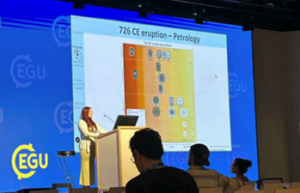
Natasha presenting her work on Santorini at EGU
The Royal Geographical Society (with IBG) is delighted to launch the Kensington Fieldwork Grants: four new annual awards of £25,000 supporting ambitious, innovative field research with the potential to deliver impact locally and globally.
Applications for the new grants are now open and will close on 8 January 2027. Find out more: Kensington Fieldwork Grant | RGS
In addition, we have increased the award values of our other research grants, including:
The deadline for these awards is 16 November 2026. – Sarah Henton De Angelis (Grants Officer, Royal Geographical Society)
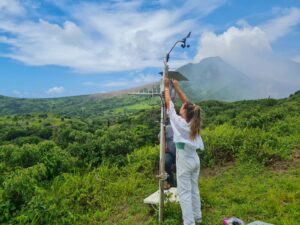
Air quality monitoring at St George’s Hill, Montserrat. This research was supported by an RGS grant. Credit: Thiffanie Williams, Montserrat Volcano Observatory.
A joint workshop by the FIAMME Project Team and the IAVCEI Commission for Volcanogenic Sediments.
How do volcanologists approach pyroclastic exposures in the field? What data do they collect and how? How could data collection be optimised for use by analogue and numerical modellers? These are questions that have been troubling the FIAMME project team, as part of the UK-based, NERC-funded project “FIAMME: (An international collaboration for a) Framework for Ignimbrite Analysis Methodologies for Modelling and hazard Evaluation”. To consider some of these questions with the wider community, we held the Recording and Interpreting Pyroclastic Stratigraphies Workshop as part of the Volcanic and Magmatic Studies Group Annual Meeting, Southampton (8th January 2026). The workshop had 15 participants from a range of career stages, from MSc students through to Principal Scientists, from different volcanological and sedimentological backgrounds.
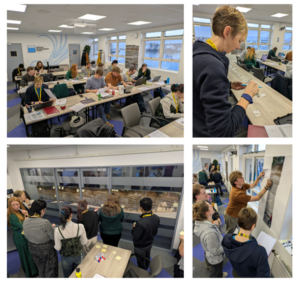
Some photos of the activities throughout the day-long workshop.
The workshop aimed to challenge the way in which we record and interpret pyroclastic stratigraphies, with a particular focus on the deposits from pyroclastic density currents.
The workshop first provided some training on recording pyroclastic sequences. We had some robust discussion of the numerous underlying assumptions and paradigms which we consciously or subconsciously carry with us into the field, and which may dictate different field work approaches.
As a group, we then approached a wall-sized image of an exposure of a pyroclastic sequence and discussed how we would tackle such a locality in our own field work and what data we would collect. We considered existing and accepted practices in qualitative and quantitative data capture, different sampling strategies and conceptual models for sequence interpretation. We practised taking quantitative measurements, with boxes of tephra circulated for participants to measure tephra clasts. Close up images enabled participants to apply a lithofacies approach to describing pyroclastic rocks. Following a logging exercise, we discussed how logging can aid in reconstructing PDC dynamics and depositional histories.
The workshop also served as a source of data for the FIAMME project. We collected the measurements, lithofacies descriptions and logs created by participants and are using these to understand the natural variability in data collection across individuals of different experience levels and career stages. By also capturing the discussions ‘at the exposure’, participants have informed work on developing a robust framework for ignimbrite analysis methodologies, for both modelling and hazard evaluation.
Thank you to all the participants for engaging enthusiastically with the workshop – a great day was had by all. – Rebecca Williams (Loughborough University; Co-Chair Commission for Volcanogenic Sediments), Pete Rowley (University of Bristol) and Natasha Dowey (Sheffield Hallam University)
Science, Society, and Solidarity
Transforming Crisis and Disaster Management Research for a Polycrisis World and the Post-2030 Global Agenda.
Join us for a critical intervention into the future of resilience. A decade of research, defining the next century of survival.
14-15 September 2026, Aston University (Birmingham, UK)
UKADR 2026 | 10th Annual Conference | Aston University
Why come along?
Whether you are keen to present your work, or join the conference to engage through the wider discussions, you are warmly welcome to the 10th Anniversary UKADR Annual Conference 2026.
Register today via the link here: https://www.ukadr2026.com/ – Amy Donovan (University of Cambridge)
We would like to extent the community’s congratulations to Dr Peter Baxter (University of Cambridge) who received an OBE in the King’s Birthday Honours for ‘services to Public Health and to Protecting Communities from Volcanic Hazards’. – VMSG Committee (with thanks to Steve Sparks for bringing it to our attention)
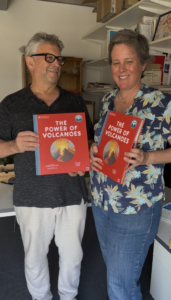
VMSG stalwarts, Tamsin Mather and David Pyle, have teamed up with illustrator Daniel Long and publishers Nosy Crow to produce a new book ‘Think Big: The Power of Volcanoes’, aimed at 7- to 11-year-olds.
When talking about the project, Tamsin said, ‘I have always wanted to write a book about volcanoes for younger readers as I think they are such an exciting way to explore thinking more deeply about our and other planets. I think that the best science books for this age group are all about combining words and pictures to tell a scientific story. Daniel’s illustrations are utterly beautiful, capture the science and are really fun to look at too. I love the way he has drawn from old pictures of eruptions as well as recent photos of volcanoes. It was fantastic to watch him develop his illustrations around our words!’
David said, ‘This was a very rewarding project – starting with the challenge of distilling our technical understanding of “how volcanoes work” into precise but accessible language for the readers. The visuals really make the book come to life. I particularly like Daniel’s images of different rocks in hand-specimen, while the image of a geothermal power plant is a direct reference to our project Rethinking Natural Resources!’
My kids would love this for sure. Maybe some small people you know might love it as well. – David Neave (Newsletter Editor)
Geoff Wadge was one of the most influential volcanologists in the UK with important contributions on volcano remote sensing, volcano deformation, volcanic hazards assessment, physical volcanology. He played a pioneering role in the application of remote sensing of active volcanoes. Geoff was educated in geology at Imperial College and came under the inspiring influence of George Walker who supervised his landmark PhD on Mount Etna in a superb documentation of magma production rates. His spent several years at the University of the West Indies in Jamaica and Trinidad and so began a life-long interest in the volcanoes and tectonics of the Eastern Caribbean. A visiting research scientist post at the Lunar and Planetary Science Unit, Houston gave him an appreciation of the potential of remote sensing to monitor volcanoes. From 1985 to his retirement Geoff was employed in the Department of Meteorology at Reading University where he pioneered research on remote sensing. His many achievements included: influential publications on high resolution geodesy of active deforming volcanoes; writing with Michael Isaacs a prophetic hazard assessment of the Soufriere Hills Volcano, Montserrat; developing the use of radar in volcanology; and being a key figure in advocating volcano-dedicated remote sensing missions. The importance of his research was recognised in 2015 with award of the Murchison Medal. – Steve Sparks (University of Bristol)
Do you have any job opportunities, PhD viva celebrations, or funding announcements that you would like to advertise? If so, please get in touch with David Neave (Newsletter Editor).
Don’t forget to keep in touch with us and other volcanologists around the world. There are several ways you can do this: through the VMSG PhD and ECR directory (here), the Arizona State University mailing list (here), and the VMSG mailing list (here).